

MDI releases a three-tier coaching model after a year of field testing, showing that small B2B teams outperform agency-led engagements when they own the process themselves.

Michigan, June 11, 2026 — The marketing agency model is in measurable decline. 45% of marketing agencies describe their business as “struggling”. 60% of senior marketing leaders are spending less on agencies in 2026. 31% of agencies are cutting junior-level positions, and less than 10% of marketing agencies survive their first three years.
Two forces are driving the collapse. First, agencies serving B2B markets have long struggled to deliver results because they operated without a clear understanding of their clients’ markets, sales cycles, or growth goals — executing tactics without strategy. Second, AI is now replacing the junior-level execution work that made up the bulk of agency billing.
For the small B2B companies that depended on them, the consequences are concrete: disconnected sales and marketing teams, no internal ownership of strategy, recurring budgets with no measurable return, and now, no one to execute. Many businesses have attempted to internalize marketing using AI, but are finding that approach equally ineffective without a system to guide it.
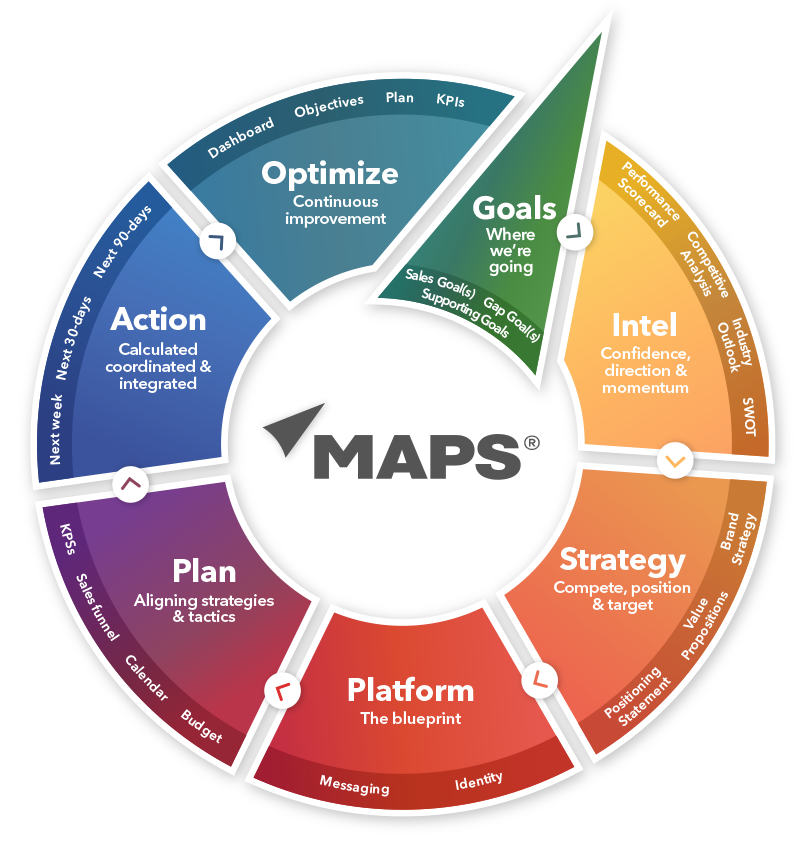
In response to what it identifies as a structural gap in how small B2B companies access marketing strategy, Marketing Department, Inc. (MDI) has released three coach-led packages built on its MAPS® revenue system — a seven-stage operating framework that embeds sales-aligned marketing processes directly inside a company’s existing team.
Unlike agency engagements, where strategy is developed externally and handed off at the end of a contract, MAPS® coaches work alongside the client team throughout the process. The team builds it. The coach guides it. Ownership stays inside the company.
“The data on agency decline is not new,” said Karyn Olsson, CEO of Marketing Department, Inc. and author of the forthcoming book on Momentum Marketing. “What’s new is that small B2B companies are now actively looking for an alternative. They no longer want to outsource their strategy. They want to own it – and AI is giving them the confidence they need to do so.”
MDI spent the past year testing and refining the MAPS® system with seven B2B companies across industries before formalizing the model into three time-bound coaching options: a 30-day engagement, a 60-day engagement, and an ongoing marketing leadership option. Engagements begin at $9,700 — compared to the $50,000–$75,000 typically billed for comparable agency strategy work.
The MAPS® system moves companies through seven sequential stages — Goals, Intel, Clarity, Platform, Plan, Action, and Optimize — each designed to connect sales goals to daily marketing execution and give every person on the team a clear role in driving revenue.
Field results from the past year’s client cohort showed consistent improvement in sales-marketing alignment, reduction in disconnected marketing activity, and stronger internal accountability within the first six months.
The packages are now available to small- and mid-sized B2B companies nationwide.
More information is available at marketingdepartmentinc.com.
About MAPS®
MAPS® (Marketing & Performance System) is a coach-led revenue system developed by Marketing Department, Inc. The seven-stage framework helps small B2B companies align sales goals, market intelligence, messaging, planning, and execution into a single, internally built and owned operating system.
About Marketing Department, Inc.
Marketing Department, Inc. is a Palm Springs-based B2B marketing strategy firm with more than 20 years of experience helping small and mid-sized companies build practical marketing systems tied directly to revenue performance. The firm’s founder, Karyn Olsson, is the author of the forthcoming MAPS Method book.
References:
Forrester analysis shows agency headcounts have fallen 8% in 2025. That’s a credible, specific, citable stat from a named source. The American ad industry lost 4,600 roles between August and December 2024 alone, according to the Bureau of Labor Statistics. Roughly 45% of marketing agencies describe their business as “it’s a struggle right now” in 2024, while only 10% say it’s “very healthy.” 60% of senior U.S. marketing leaders said they spend less on agencies in 2025 as a direct result of AI, according to Typeface research. 23% of agencies reduced junior copywriting headcount in 2025, and 31% plan further cuts in 2026. WPP — the world’s largest agency reports stock down roughly 40% over the past year.